The 'Dhokla Diplomacy' Debate: Culinary Hegemony, Diasporic Anxiety, and the Unapologetic Rise of Indian Soft Power
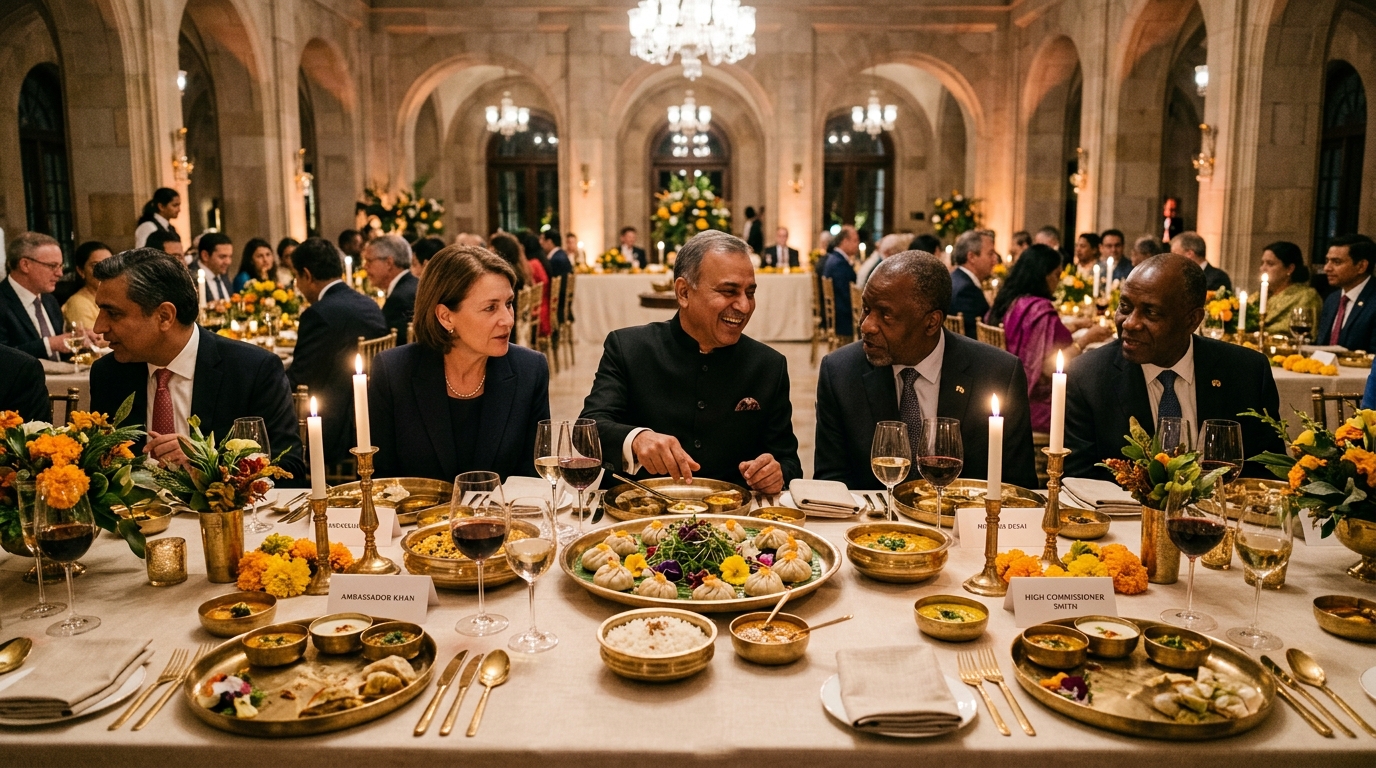
I. The Facebook Discontent
It began, as so many modern cultural tremors do, in a closed digital square.
Inside the private 196,000-member community of Indian Expats in USA—a bustling cross-section of software architects in Sunnyvale, energy executives in Houston, cardiologists in Cleveland, and biotech founders in Boston—a contentious thread ignited over international protocol.
The prompt was direct and sharp. Sanjib Bhowmick, a veteran diaspora voice, posted a fierce critique of recent state banquets hosting foreign dignitaries:
"BRIC Summit Food menu was really awful disgusting overall. Foreign guests must have been surprised to see all VEGETARIAN menu. Why one must push Dhokla/Thepla in an international level meeting. Not a very good idea."
Within hours, the post drew nearly 300 comments, turning into a fiery referendum on taste, diplomacy, and civilizational confidence.
The counter-reaction was immediate. Amol Chokshi shot back:
"Really? So, according to you only meat & European food is International? If BRICS is in Brazil, will they not serve their dishes?"
Another contributor, Prash Ku, reminded the room of precedent:
"Did you not know, even at the G20 summit in 2023, they served an all-vegetarian menu? Why are you surprised?..."
To dismissal-minded observers, this was merely another late-night social media squabble over banquet catering. But beneath the surface of steamed fermented gram flour, mustard seeds, and spiced flatbreads lies a much deeper socio-political fault line: The crisis of culinary hegemony and the psychological lingering of the post-colonial cringe.
Why does an all-vegetarian indigenous banquet make certain segments of the diaspora squirm with second-hand embarrassment, while others view it as the ultimate expression of geopolitical self-assurance?
II. The Protocol of the Imperial Palate
For more than two centuries, the unspoken grammar of multilateral diplomacy was dictated by the courts of Western Europe.
Following the Congress of Vienna in 1815, diplomatic dining was standardized around French haute cuisine. A "serious" state banquet demanded specific rituals: a multi-course progression anchored by roasted beef tenderloin, duck confit, or poached salmon, flanked by heavy cream reductions, refined bread service, and vintage European wine pairings.
When post-colonial nations entered the international arena in the mid-20th century, their foreign ministries largely adopted this template out of an anxious desire to project "sophistication" and institutional parity.
| ERA | CULINARY STRATEGY | REPRESENTATIVE DISHES | DIPLOMATIC SUBTEXT | | :--- | :--- | :--- | :--- | | 1950s – 1980s (Post-Independence) | Anglo-French Mimicry with sanitized curries | Consommé, Roast Lamb, Creamed Potatoes | "We can conform to Geneva standards of protocol." | | 1990s – 2010s (Economic Opening) | Pan-Indian "Mughlai" 5-star hotel neutrality | Butter Chicken, Naan, Dal Makhani, Paneer | "Safe, standardized luxury that won't startle foreign guests." | | 2020s – Present (The Multipolar Era) | Civilizational Assertion: Regional & Ayurvedic | Fermented Millets, Dhokla, Thepla, Rasam | "We set our own table. Indigenous gastronomic sovereignty." |
For decades, Rashtrapati Bhavan and South Block followed a cautious hybrid script. If Indian food was served, it was almost invariably sanitized into the butter-laden, cream-heavy, five-star hotel idiom of Anglo-Mughlai cuisine: Butter Chicken, Dal Makhani, Paneer Tikka, and Naan. It was delicious, but it was safe, homogenized, and designed specifically not to offend an imaginary Western palate.
Regional staples—the steamed, sour fermented cakes of Gujarat (Dhokla), the fenugreek-infused unleavened breads (Thepla), the tamarind-peppercorn broths of Tamil Nadu (Rasam), or the coarse pearl-millet porridge of Rajasthan (Bajra Khichdi)—were treated as domestic, parochial, or provincial. They were what one ate in private kitchens, not what one presented to heads of state under crystal chandeliers.
III. The Diaspora's "Lunchbox Syndrome"
To understand why an expat would recoil at Thepla on a summit table, one must understand the sociological conditioning of first-generation emigration.
Almost every Indian professional who moved to North America or the United Kingdom between 1980 and 2010 carries what sociologists term "The Lunchbox Syndrome."
As school children or young corporate transplants, their food was marked as "other." The pungent aroma of asafoetida (hing), turmeric, and mustard seeds tempering in hot ghee drew snickers, wrinkled noses, and complaints in school cafeterias and office breakrooms. The instinctive defense mechanism was either to sanitize one's diet—adopting sandwiches, pasta, and salads—or to strictly quarantine Indian food to the domestic sphere.
For that generation, "international" became synonymous with Anglo-European neutrality. To be accepted on the global stage required shedding ethnic markers that might provoke discomfort.
Consequently, when that same professional sees an Indian Prime Minister serve steamed Dhokla, unpolished millets, and coconut-tempered vegetables to G7 and BRICS heads of state, an old psychological reflex misfires: Will the foreigners laugh at us? Will they think we are unrefined?
IV. The Asymmetry of Culinary Sovereignty
The absurdity of this anxiety becomes clear the moment one examines how other civilizational states conduct gastro-diplomacy.
When French President Emmanuel Macron hosts a state banquet at Versailles, he does not serve chicken tikka or dim sum to make visiting Asian or African leaders feel comfortable. He serves blue cheese, foie gras, duck breast, and vintage Bordeaux.
When a foreign leader lands in Tokyo, the Japanese Ministry of Foreign Affairs does not offer grilled beef steaks with French fries out of fear that raw fish might alienate the guest. They serve Kaiseki—unapologetically presenting raw sea urchin, fermented soybean paste, seaweed broths, and matsutake mushrooms.
No Japanese expat in Dallas or London takes to Facebook to wail: "Foreign guests must have been surprised to see raw fish! Why push sushi at an international meeting?"
On the contrary, Japan's unwavering cultural pride elevated sushi from a regional working-class street food in the Edo period into the apex global currency of fine dining.
Why should India—possessing the world’s oldest, most scientifically intricate, and diverse culinary canon spanning 5,000 years of botanical and Ayurvedic wisdom—be the only civilizational state expected to apologize for its diet?
V. Vegetarianism as the Frontier, Not the Compromise
The irony of the "surprise over an all-vegetarian menu" is even more profound when viewed through the lens of 21st-century planetary health and sustainability.
For decades, Western fine dining dismissed vegetarianism as an ascetic lack, a clinical deprivation, or an afterthought. Today, the most prestigious three-Michelin-star restaurants in Paris, Copenhagen, and New York—from Alain Passard’s L'Arpège to Daniel Humm’s Eleven Madison Park—have abandoned animal proteins in pursuit of plant-forward gastronomy, citing carbon footprints, soil regeneration, and biochemical longevity.
Yet, while Western culinary institutions scramble to reinvent plant-based cuisine using ultra-processed meat analogues and laboratory hydrocolloids, India has spent millennia perfecting a complete, sophisticated, and delicious plant-first architecture:
- Fermentation Mastery without Dairy: Foods like Dhokla and Idli harness wild lactic acid fermentation to break down phytic acid, boost bioavailability, and cultivate gut microbiome resilience centuries before modern gastroenterology coined the term "prebiotic."
- The Six Tastes (Shad Rasa): Classical culinary physiology mandates that a complete meal must incorporate sweet, sour, salty, bitter, pungent, and astringent notes. A traditional Gujarati thali—with the tartness of tempered buttermilk, the subtle sweetness of steamed lentils, the astringency of fenugreek leaves, and the punch of mustard crackle—is an engineering feat of metabolic harmony.
- Millet Renaissance (Shree Anna): When India championed the UN International Year of Millets, it was not merely an agricultural slogan. Sorghum, finger millet (ragi), and pearl millet (bajra) are climate-resilient, drought-resistant supergrains that modern endocrinology now recognizes as the ultimate shield against global metabolic dysfunction and insulin resistance.
To present this culinary heritage at a global summit is not an embarrassing provincial slip. It is an act of intellectual leadership. It offers the world a living, historic blueprint of sustainable planetary dining.
VI. The New Diasporic Confidence
Fortunately, the anxieties voiced in Facebook groups reflect a generational sunset rather than the future.
A younger, self-assured generation of the Indian diaspora—those building AI unicorns, running investment desks, writing literature, and winning Michelin stars in Manhattan, London, and San Francisco—views their heritage with entirely different eyes.
They do not hide their dabbas. They do not rebrand their turmeric as "golden milk" to make it palatable to suburban grocery shoppers. They understand that true soft power does not come from how well you mimic someone else's silverware; it comes from having the civilizational dignity to invite the world to sit on your carpet and eat from your plate.
The "Dhokla Diplomacy" debate is ultimately not about what was served on a plate at a BRICS or G20 dinner.
It is about whether India—and its 35-million-strong global diaspora—believes it has earned the right to define what is refined, what is prestigious, and what is worthy of the global stage.
The banquet tables of New Delhi have answered that question. It is time for the rest of the world—and the diaspora itself—to take a seat, pick up the fork, and savor the revolution.
Related Stories

The Tutoring Trap: Why Worksheets and Gamified Apps Are Failing Our Children—and How Adaptive Socratic AI Is Changing the Math
Executive Summary: The Modern Learning Paradox If you walk into the living room of an ambitious suburban household at 6:30 PM on a Tuesday, the scene is almost universally the same: an exhausted child sitting over a stac...

The Texas Paradox: Bo French, the 'Perpetual Foreigner' Myth, and the New Reality of Indian-American Power
I. The Longhorn Stadium Snapshot On a warm Saturday afternoon in Austin, Texas, tens of thousands of college students packed the bleachers of Darrell K Royal–Texas Memorial Stadium. Among them was a cluster of young Sout...

The 3:00 AM Awakening: Why Your Nervous System Surges in the Quiet of Night
There is a particular kind of exhaustion that arrives not when your head hits the pillow, but five hours later. You wake up between 2:00 and 4:00 in the morning. The room is dark and silent, yet your eyes are wide open....