The Texas Paradox: Bo French, the 'Perpetual Foreigner' Myth, and the New Reality of Indian-American Power
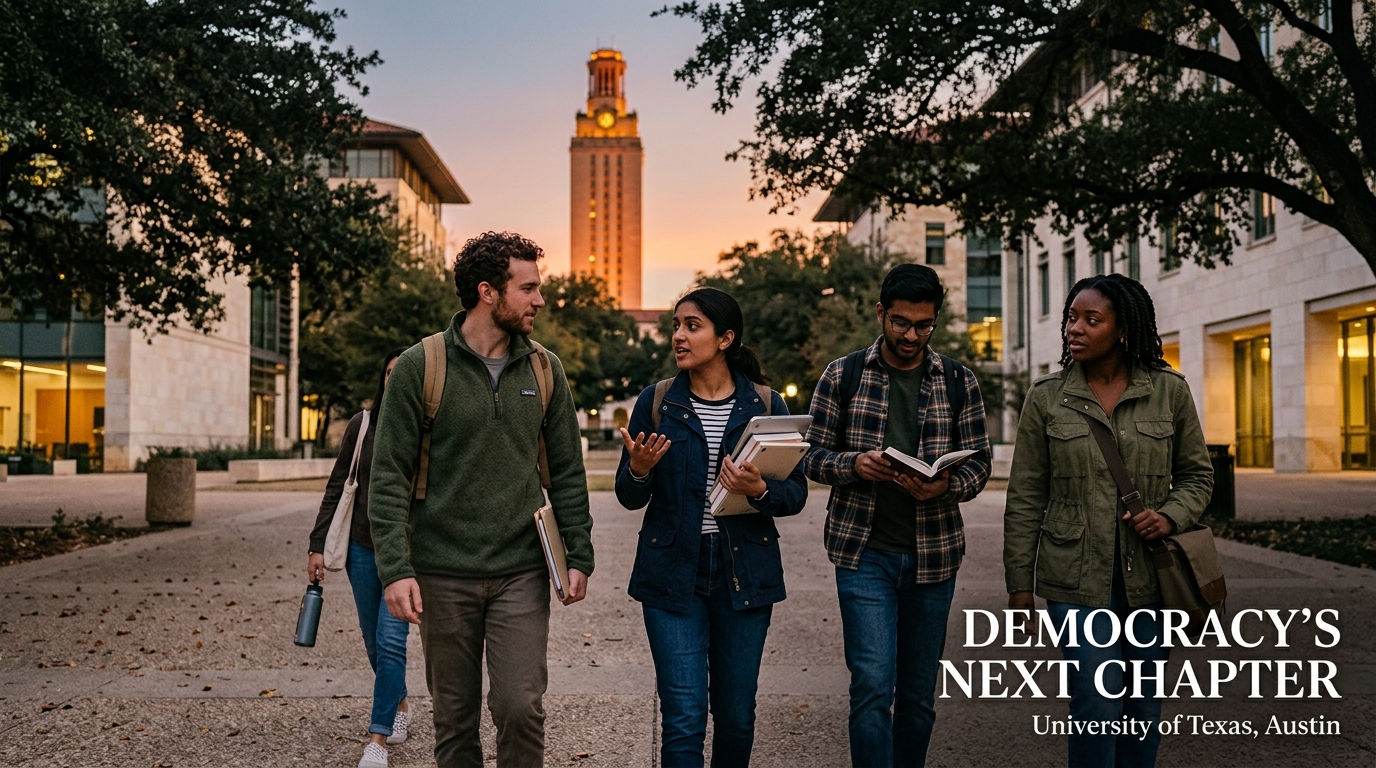
I. The Longhorn Stadium Snapshot
On a warm Saturday afternoon in Austin, Texas, tens of thousands of college students packed the bleachers of Darrell K Royal–Texas Memorial Stadium. Among them was a cluster of young South Asian undergraduate students—decked in burnt orange, singing "The Eyes of Texas," their arms raised in the universal Longhorn salute.
To any casual observer of modern Texas, the image was utterly unexceptional. The University of Texas at Austin has long drawn the most mathematically gifted, academically competitive young minds from across the state—from the technology corridors of Plano and Frisco to the medical research hubs of Houston and the energy boardrooms of Dallas.
Yet within hours, that photograph became the focal point of a venomous online furor. Bo French, the influential Tarrant County Republican Party Chairman and candidate for statewide office, circulated the image to hundreds of thousands of followers, lamenting the sight as proof of "foreigners displacing Americans" on Texas soil.
The blowback was immediate, bipartisan, and unusually sharp. Conservative leaders—most prominently U.S. Senator John Cornyn—forcefully rebuked French, with Cornyn stating plainly that such xenophobic rhetoric does not reflect the Republican Party, Texas values, or the basic economic reality of the Lone Star State.
The episode was dismissed by many as the isolated fringe outburst of an attention-seeking politico. But to reduce Bo French’s tweet to internet theater is to misunderstand its deeper cultural diagnostic. It exposed a fundamental structural friction at the heart of 21st-century American life: The Texas Paradox.
II. The Economic Miracle and the Inconvenient Neighbor
For the past twenty years, Texas political and civic leaders have executed one of the most successful economic recruiting campaigns in modern American history.
Under the banner of the "Texas Miracle," the state aggressively lured corporate headquarters, semiconductor fabs, aerospace defense contractors, enterprise software conglomerates, and clinical biotechnology networks away from high-tax, high-regulation jurisdictions like California, New York, and Illinois.
The proposition was simple: zero state income tax, pro-business deregulation, world-class municipal infrastructure, and low commercial utility rates.
Companies came by the hundreds: Tesla, Oracle, Apple’s second mega-campus, Charles Schwab, Samsung’s mammoth Taylor fab, and Texas Instruments’ massive silicon expansion.
┌────────────────────────────────────────────────────────────────────────────────────────────────────────┐
│                              THE TEXAS HIGH-TECH GROWTH ENGINE & THE DIASPORA                          │
├─────────────────────────┬──────────────────────────┬───────────────────────┬───────────────────────────┤
│ METRO REGION            │ PRIMARY INDUSTRY CLUSTER │ DIASPORA DEMOGRAPHIC  │ ECONOMIC CONTRIBUTION     │
├─────────────────────────┼──────────────────────────┼───────────────────────┼───────────────────────────┤
│ Dallas-Fort Worth       │ Telecomm, FinTech, SaaS  │ Frisco, Plano, Irving │ $4.8B local municipal tax │
│ Austin (Silicon Hills)  │ Chips, AI, Autonomous    │ Round Rock, Cedar Pk  │ ~28% engineering talent   │
│ Houston (Energy/Med)    │ Clinical Trials, LNG     │ Sugar Land, Katy      │ ~32% specialized MDs      │
└─────────────────────────┴──────────────────────────┴───────────────────────┴───────────────────────────┘
Herein lies the paradox: You cannot build a multi-trillion-dollar knowledge economy without the knowledge workers.
Texas leaders courted enterprise AI, semiconductor lithography, and cloud infrastructure. But enterprise AI and semiconductor foundries are not built on rhetoric; they are built on advanced degrees in electrical engineering, linear algebra, distributed systems, and computer science.
And for three generations, the primary demographic filling those grueling engineering seats, patent filings, and clinical residencies has been the Indian-American diaspora.
Between 2010 and 2026, the Indian-American population in Texas more than doubled, surpassing 550,000 residents. In cities like Frisco—the fastest-growing suburb in America—Indian-Americans transformed sleepy farmland into premier master-planned communities, funding top-rated public school districts through property taxes, dominating spelling bees, building community hospitals, and founding breakout tech startups.
The nativist reflex illustrated by Bo French wants the tax revenue of the semiconductor fab, the prestige of the medical center, and the property tax dollars that fund the stadium—without having to see the brown engineer who designed the circuit sitting in the front row of the football game.
III. The Myth of the "Perpetual Foreigner"
The deepest insult in the Bo French episode was not partisan; it was epistemological. By describing Texas university students as "foreigners," French revealed the enduring durability of the Perpetual Foreigner Trope.
In the nativist imagination, assimilation is not measured by:
- Paying six figures in municipal, state, and federal taxes.
- Pledging allegiance to the Constitution as naturalized citizens or third-generation native-born Americans.
- Founding businesses that employ dozens of native-born Texans.
- Serving on municipal school boards, civic trusts, and volunteer fire departments.
In that flattened worldview, American identity is determined strictly by ancestry and aesthetics. A fourth-generation citizen of Asian or Indian descent is instinctively categorized as a "guest," while an immigrant from Western Europe is instantly assumed to be a local.
This double standard is felt with acute poignancy by the 1.5 and second-generation children of immigrants—young people born in Dallas, Houston, or Plano, who grew up on Tex-Mex, root for the Dallas Cowboys, speak with subtle Texas drawls, and know no country other than the United States. To look down at your college football bleachers and be told by a political leader that you are "displacing Americans" is a jarring reminder that for some, full civic acceptance is always conditioned on an unspoken asterisk.
IV. The H-1B Purgatory and the Shift to Civic Power
The Bo French controversy does not exist in a vacuum. It comes amid a broader climate of escalating political rhetoric targeting legal immigration:
- The 100-Year Green Card Backlog: Hundreds of thousands of Indian engineers and physicians in Texas and across the United States remain trapped in decades-long EB-2 and EB-3 green card backlogs—paying full taxes, buying homes, and raising American-born children, yet tethered to rigid H-1B employer visas that leave their entire legal existence hanging on a 60-day grace period.
- Suburban Council Friction: In Frisco and North Texas city council meetings over the past year, municipal hearings have been disrupted by vocal nativist agitators accusing Indian homeowners of "H-1B fraud" and holding signs proclaiming "Don't India My Texas."
- Property Ownership Restrictions: Legislative bills targeting foreign property ownership (such as Texas SB 147 and its successors) have sent chilling signals to legal immigrant families evaluating whether to invest their life savings in Texas soil.
Yet, there is a silver lining emerging from this turbulence: the end of the quiet economic passenger.
Historically, the first generation of Indian immigrants in the United States adhered to an unwritten survival philosophy: Keep your head down. Excel at your company. Don't cause trouble. Let your bank account and your children’s SAT scores speak for you.
That era is dead.
The Indian-American community is rapidly learning that economic success without political muscle is an optical illusion. Wealth without representation is vulnerability.
From municipal councils in Frisco and Sugar Land to the state Capitol in Austin and congressional delegations in Washington, Indian-Americans are stepping up to run for office, organizing political action committees, funding voter registration drives, and demanding accountability from politicians who solicit their campaign donations in private while tolerating or echoing nativist slurs in public.
V. The Road Ahead
Texas has always prided itself on being a frontier of unapologetic ambition—a place where the measure of a person is determined not by where their grandfather came from, but by the size of the enterprise they can build, the cattle they can run, or the future they can engineer.
If Texas is to remain the economic powerhouse of the Western world, it must resolve its cognitive dissonance. The young men and women in the bleachers at UT Austin are not "displacing" America. They are America.
They are the engineers designing the next generation of generative intelligence, the oncologists conducting clinical immunotherapy trials in Houston, the founders building enterprise technology, and the taxpayers underwriting the state’s civic institutions.
Bo French may pine for a static, sepia-toned past that exists only in political mythology. But the students in Austin, chanting Longhorn battle cries under the Texas sun, are already building the state’s future. And no tweet can stand in the way of demographic and intellectual reality.
Related Stories

The Tutoring Trap: Why Worksheets and Gamified Apps Are Failing Our Children—and How Adaptive Socratic AI Is Changing the Math
Executive Summary: The Modern Learning Paradox If you walk into the living room of an ambitious suburban household at 6:30 PM on a Tuesday, the scene is almost universally the same: an exhausted child sitting over a stac...

The 3:00 AM Awakening: Why Your Nervous System Surges in the Quiet of Night
There is a particular kind of exhaustion that arrives not when your head hits the pillow, but five hours later. You wake up between 2:00 and 4:00 in the morning. The room is dark and silent, yet your eyes are wide open....

The 2026 Enterprise Innovation Benchmark: Accelerators vs. Venture Client Units vs. Curated Adoption Desks
Executive Summary: The Five-Year AI Re-Buy Window Over the next 60 months, the core software and operational systems of the Fortune 500 and Global 1000 will undergo their most aggressive capital replacement cycle in deca...